 Overview and Applications
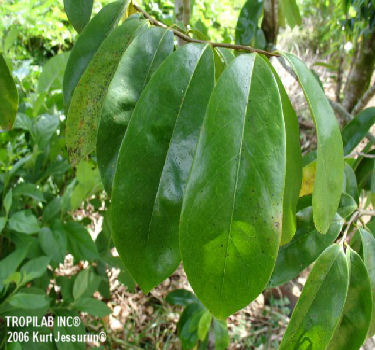
Soursop or Graviola, native to the Amazon rainforest; is a small tree
growing up to 15 feet (5 meters) tall. It is much sought after for its delicious fruit.
However, Graviola bark, leaves, root, and fruits have also been used as traditional remedies in South
America for many centuries.
There is ongoing cancer-research on this plant concerning the specific phytochemicals (Annonaceous acetogenins)
that are demonstrating the strongest anticancer and antiviral properties.
Extracts have many benefits such as antiviral, antiparasitic, antirheumatic, astringent,
emetic, antileishmanial and cytotoxic effects. Graviola has also been shown to be effective against multi-drug resistant
cancer cell lines.
Graviola seems to effectively target and kills malignant cells in more than 10 different
types of cancer, including colon, breast, prostate, lung, and pancreatic cancer.
It can be regarded as an effective natural cancer drug that inhibits the growth of cancer cells while it
doesn’t damage healthy ones.
It is believed to be far stronger in killing colon cancer cells than Adriamycin® (Doxorubicin hydrochloride),
a chemotherapy given as treatment for certain types of cancer. Graviola may be a natural alternative as such for traditional
cancer treatments.
Graviola hunts down selectively - and kills cancer cells without harming healthy cells; unlike
chemotherapy that indiscriminately seeks and destroys all actively reproducing cells - (even normal, healthy
ones).
Research on this plant has focused on its anti-cancerous effect but the plant has been used for a
long time in traditional medicine in South America to treat a number of ailments, such as:
hypertension, ringworm, influenza, scurvy, rashes, malaria, neuralgia, dysentery, arthritis, palpitations, rheumatism, nervousness,
high blood pressure, insomnia, diarrhea, fever, nausea, boils, dyspepsia, and muscle spasm.
General uses are: cancer treatment, herpes, infections, parasitic infections and sedation.
Phytochemicals
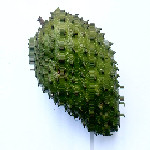
There are many constituents in Graviola (Soursop).
Acetogenins, quinolines, isoquinolines, annopentocins and annomuricins, Coreximine,
reticuline subfractions.
Acetaldehyde, Amyl-caproate, Amyloid, Annonain, Anomuricine, Anomuricinine, Anomurine,
Anonol, Atherosperminine, Beta-sitosterol, Campesterol, Cellobiose, Citric-acid, Citrulline, Coclaurine, Coreximine,
Dextrose, Ethanol, Folacin, Fructose, Gaba, Galactomannan, Geranyl-caproate Glucose, HCN, Isocitric-acid,
Lignoceric-acid, Malic-acid, Manganese, Mericyl-alcohol, Methanol, Methyl-hex-2-enoate, Methyl-hexanoate, Muricine,
Muricinine, Muricapentocin, Muricoreacin, Myristic-acid, P-coumaric-acid, Paraffin, Potassium-chloride, Procyanidin,
Reticuline, Scyllitol, Stearic-acid, Stepharine, Stigmasterol, Sucrose, Tannin, Xylosyl-cellulose.
Pharmacology
Methanolic extract of Annona muricata (Annonaceae) seeds was tested for antiparasitic
activity against E. histolytica, N. brasiliensis, M. dessetae and A. salina.
The acetogenins (these are natural chemicals) are found to be responsible for that important activity.
In a plant screening program by the National Cancer Institute (NCI), the leaves and stem of Graviola showed active cytotoxicity against cancer cells.
Focus of the research was on a novel set of phytochemicals (annonaceous acetogenins).
The Annonaceous acetogenins are only found in the Annonaceae family.
Fractionation of the leaves resulted in the isolation of two new Annonaceous acetogenins, muricoreacin and murihexocin C.
These compounds showed significant cytotoxicities among six human tumor cell lines with selectivity to the prostate
adenocarinoma (PC-3) and pancreatic carcinoma (PACA-2) cell lines.
The antitumor, properties of these annonaceous acetogenins have been reported.
Researchers also reported that the Annonaceous acetogenin, bullatacin, preferentially killed multi-drug resistant cancer
cells because it blocked production of adenosine triphosphate, ATP (the chief energy-carrying compound).
However the Annonaceous acetogenins also appear in other species from this family such as Annona
Montana.
Over 350 of these acetogenins have been isolated from 37 species.
Some of the Annonaceous acetogenins are not only effective in killing tumors that have proven resistant to anti-
cancer agents, but also seem to have a special affinity for such resistant cells.
Surviving cancer cells from chemotherapy may develop resistance to the agent originally used against them as
well as to other, even unrelated, drugs (multi-drug resistance or MDR).
The fruit and the leaves of Annona
muricata are used in traditional medicine for their tranquillizing and sedative properties.
Extracts of the plant have been shown results that imply that the fruit possesses anti-depressive effects,
possibly induced by three alkaloids, annonaine (1), nomuciferine (2) and asimilobine (3), isolated from the fruit.
Fractionation of the leaves resulted in the isolation of annopentocins A B and C and cis- and trans-annomuricin-D-ones.
Compound 1 was selectively cytotoxic to pancreatic carcinoma cells (PACA-2), and 2 and 3 were selectively cytotoxic
to lung carcinoma cells (A-549); the mixture of 4 and 5 was selectively cytotoxic for the lung (A-549), colon (HT-29),
and pancreatic (PACA-2) cell lines with potencies equal to or exceeding those of Adriamycin® (Doxorubicin). This is
a medication used in cancer chemotherapy.
One of the documented mechanisms of action from Graviola is by decreasing energy to abnormal cells (ATP-inhibitor).
Taking supplements that increase cellular energy, such as CoQ10, will counteract or disable this one mechanism of
action of Graviola!
GRAVIOLA FORTE
This is the combination of the species Annona muricata and
Annona montana.
Since Graviola (Annona muricata) does not contain all the acetogenins, combining it with the Montana
species considerably increases the working constituents.
Dosage
The leaves are used for the herbal dietary supplement.
Crushed leaves for the herbal tea and an extract from the leaves for the herbal tincture.
Tincture: 1 - 4 ml. daily (1 - 4 full droppers).
Infusion: herbal tea from Graviola (Soursop): 1 - 3 cups daily.
This tea is naturally caffeine free.
Precaution & contra-indications
Not to be used during pregnancy due to possible uterine stimulant activity.
Contraindicated for people with low blood pressure (it may posses' hypotensive, vasodilator, and cardio depressant
activities).
It may also potentiate antidepressant drugs and interfere with MAO-inhibitor drugs.
Long-term use of Graviola might lead to some die-off of friendly bacteria in the digestive tract. Supplementing
the diet with digestive enzymes may be helpful to counteract this possible effect.
References
Titre du document / Document title
Isoquinoline derivatives isolated from the
fruit of Annona muricata as 5-HTergic 5-HT[1A] receptor agonists in rats : Unexploited antidepressive (lead) products.
Auteur(s) / Author(s)
HASRAT J. A.(¹); DE BRUYNE T.(¹); DE BACKER J.-P.(²); VAUQUELIN G.(²);
VLIETINCK A.(¹)
Affiliation(s) du ou des auteurs / Author(s) Affiliation(s)
(¹) Department of Pharmaceutical Sciences,
University of Antwerp, Universiteitsplein 1, 2610, Antwerp, BELGIQUE.
(²) Department of Protein Chemistry,
Free University of Brussels, Paardenstraat 65, 1640, St Genesius Rode, BELGIQUE.
Two New Mono-Tetrahydrofuran Ring Acetogenins, Annomuricin E and Muricapentocin, from the Leaves of Annona muricata.
Geum-soog Kim, +§Lu Zeng, +Feras Alali, +Lingling L. Rogers, +Feng-E. Wu, +Jerry L. McLaughlin,*+ and Soelaksono Sastrodihardjo±
Department of Medicinal Chemistry and Molecular Pharmacology, School of Pharmacy and Pharmacal Sciences, Purdue University,
West Lafayette, Indiana 47907, and Department of Education and Culture, Center of Interuniversities, Biology Division, Bandung
Institute of Technology, 10 Yanesba St., Bandung 40132, Indonesia Received November 26, 1997.
Department of Medicinal Chemistry and Molecular Pharmacology, School of Pharmacy and Pharmacal Sciences, Purdue University,
West Lafayette, Indiana 47907, and Department of Education and Culture, Center of Interuniversities, Biology Division,
Bandung Institute of Technology, 10 Yanesba St., Bandung 40132, Indonesia Received November 26, 1997.
Annona muricata L. USDA, NRCS. 2008. The PLANTS Database http://plants.usda.gov/ , Nov, 2008).
National Plant Data Center , Baton Rouge, LA 70874-4490 USA.
Wu FE, Zeng L, Gu ZM, et al. Muricatocins A and B, two new bioactive monotetrahydrofuran Annonaceous acetogenins
from the leaves of Annona muricata. J Nat Prod. 1995;58(6):902-908.
The above presentation is for informational and educational purposes only.
It is
based on scientific studies (human, animal, or in vitro), clinical experience, or traditional usage.
For many of
the conditions discussed, treatment with prescribed (RX) or over - the - counter (OTC) medication is also available.
Consult your doctor, practitioner, and/or pharmacist for any health problem and before using dietary supplements
or before making any changes in prescribed medications.
|
For the right freight rate, please visit our Webstore page!
|
|



) Overview and Applications
Overview and Applications)