 |
|
| TONKA TINCTURE (tinctura DIPTERYX ODORATA) from AMAZON HERBS® |
 |
 |
 Overview
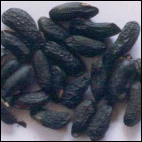
The seeds are used medicinally; they are black and wrinkled in appearance, with a smooth brown interior. Tonka tincture has been used extensively in the flavoring of cured tobacco leaves, due to their vanilla like odor but there are also other applications. It is traditionally used for snakebites, cuts, contusions, coughs and rheumatism. In Traditional Medicine in Surinam, Cumaru (Tonka) is considered to have antispasmodic, emmenagogue, cardio-tonic and anti-asthmatic actions. Potential cancer chemo-preventive constituents from the seeds of Dipteryx odorata (Tonka bean) have been identified by research. Tonka aka Brazilian teak, is also a much sought after wood and is known for its exceptional hardness and durability. Constituents The seeds contain: a new cassane diterpene, dipteryxic acid and a new isoflavonolignan, 5-methoxyxanthocercin A. Four known active compounds, isoliquiritigenin (6,4'-dihydroxy-3'-methoxyaurone, sulfuretin (5), and (+/-)-balanophonin, and five known inactive compounds, butin, eriodictyol, 7-hydroxychromone, 7,3'-dihydroxy-8,4'-dimethoxyisoflavone, and (-)-lariciresinol. These are potential cancer chemo-preventive constituents. Retusin (O-methylated isoflavone), coumarin glycosides. The major components of the flowers: germacrene D (31.1%), bicyclogermacrene (13.0%) and spathulenol (11.3%). Pharmacology ) Heartwood extracts from Dipteryx odorata exhibit antioxidant activities
comparable with that of α-tocopherol, a well-known antioxidant; this is one of several forms of
vitamin E.
Heartwood extracts from Dipteryx odorata exhibit antioxidant activities
comparable with that of α-tocopherol, a well-known antioxidant; this is one of several forms of
vitamin E.The tonka bean contains coumarin which condensed derivatives are used as an anti-coagulant (blood thinner). The beans can contain 1% - 3% coumarin. However, some strains have tested as high as 10%. Coumarin has a vanilla-like flavor; it can lead to liver disease in very large doses. It acts as a strong antagonist to vitamin K and prevents blood coagulation. The derivatives of coumarin are commercially marketed as a prescription drug: Coumadin© (Warfarin). It is used as a blood thinner (anticoagulant) to keep blood flowing smoothly and prevent formation of blood clots. Other activities of the Tonka beans are, anti-fungicidal and anti-tumor. In herbal therapeutics though, the primary use of coumarin-containing plants, such as Tonka, is anti-edema and tonifying venous circulation. The seeds have potential cancer chemo-preventive constituents. The active compound, isoliquiritigenin was found to exhibit 76% inhibition in cultured Hepa 1c1c7 mouse hepatoma cells. For more information on Tonka, go to the "Dipteryx odorata plant" page. Dosage Tincture: not for internal use; check with your qualified herbal- or homeopathic health provider. Warning The Tonka beans (seeds) are considered poisonous when used at high doses for a long period. Internal use is not recommended since it may be hepatotoxic. Do not use together with blood thinning drugs. Reference Potential cancer chemopreventive constituents of the seeds of Dipteryx odorata (tonka bean). Dae Sik Jang, Eun Jung Park, Michael E Hawthorne, Jose Schunke Vigo, James G Graham, Fernando Cabieses, Bernard D Santarsiero, Andrew D Mesecar, Harry H S Fong, Rajendra G Mehta, John M Pezzuto, A Douglas Kinghorn Program for Collaborative Research in the Pharmaceutical Sciences and Department of Medicinal Chemistry and Pharmacognosy, University of Illinois at Chicago, 60612, USA Heartwood extractives from the Amazonian trees Dipteryx odorata, Hymenaea courbaril, and Astronium lecointei and their antioxidant activities. Takanori Imai, Sousuke Inoue, Naomi Ohdaira, Yasuyuki Matsushita, Rie Suzuki, Mariko Sakurai, José Manoel Henriques de Jesus, Salete Kiyoka Ozaki, Zenesio Finger and Kazuhiko Fukushima The above presentation is for informational and educational purposes only. It is based on scientific studies (human, animal, or in vitro), clinical experience, or traditional usage. For many of the conditions discussed, treatment with prescribed (RX) or over-the-counter (OTC) medication is also available. Consult your doctor, practitioner, and/or pharmacist for any health problem and before using dietary supplements or before making any changes in prescribed medications. |
For the right freight rate, please visit our Webstore page! |
|
TROPILAB® INC copyright disclaimer |